
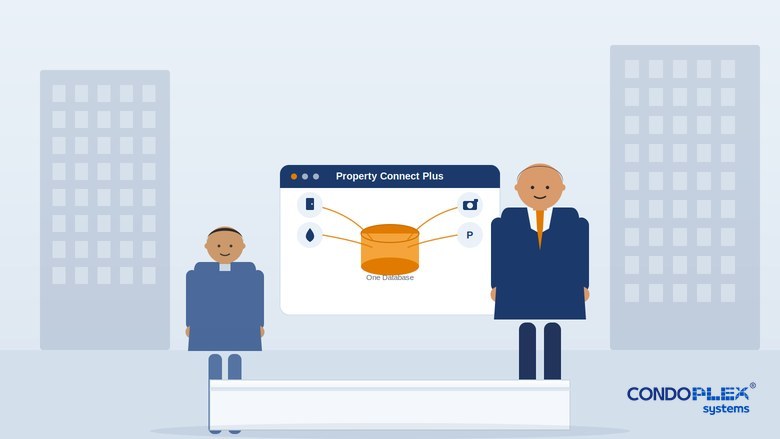
One Database Changes Everything: How Condoplex Is Getting Buildings Ready for Edge AI
Most buildings run on a patchwork. The intercom is one vendor. The cameras are another. Access control, parking, water sensors — each bolted on at a different point in the building's life, each with its own software, its own login, its own way of storing data. It works, mostly. But it means nothing in that stack actually talks to anything else.
That gap matters more than it used to, because the next wave of building technology isn't another point solution — it's AI, and AI is only as good as the data it can see. A fragmented system can't give it much to work with.
The Problem With a Fragmented Stack
When every system in a building keeps its own separate records, no single piece of software ever sees the whole picture. A door forced open, a camera catching movement in the same hallway, a parking gate cycling at 2 a.m. — on a fragmented stack, those three events live in three different databases that were never designed to speak to each other. Correlating them means a person pulling logs from three dashboards after the fact, if anyone thinks to look at all.
Property Connect Plus was built to close that gap. It's one platform and one database behind telephone entry, access control, suite alarms, intercom, parking, smart locks, water detection, and CCTV — plus a failover server design that keeps the building running even if the internet connection doesn't. Every event, from every system, lands in the same place, in real time.
That's not just tidier. It's the prerequisite for the next part.
The Physical World Doesn't Wait on the Cloud
Here's the piece that gets glossed over in most AI conversations: the cloud is very good at reasoning over data after the fact — spotting a trend across a thousand buildings, refining a model, generating a report. What it's not built for is acting on the physical world in real time.
A door has to unlock the instant a valid badge is presented, not a few hundred milliseconds later while a request travels to a data center and back. A gate has to open before the car in front of it stops. A valve has to shut the moment a leak sensor fires, not after a round trip to a server that may be hundreds of kilometres away. Every one of those actions happens in a physical space, on a physical timeline, and the internet doesn't move at the speed the physical world needs — even under ideal conditions, a cloud round trip adds delay that a person standing at a door or a leak spreading across a floor can't afford to wait through.
Then there's the case that matters most: when the internet drops entirely. A cloud-only AI goes dark exactly when a building needs it most — during a storm, a local outage, an ISP failure. A door still needs to open for the right person and stay shut for the wrong one. A valve still needs to close. None of that can be outsourced to a data center that might not be reachable. It has to run on hardware physically present in the building, making the decision on the spot.
That's the actual argument for edge AI. It's not that the cloud is bad — it's that the cloud can analyze the physical world, but it can't act in it, not reliably, not in real time. Something local has to be able to make the call.
What “Edge AI” Actually Means
“Edge AI” is the AI that runs on that local hardware — the door controller, the camera, the on-site building server — instead of only in a remote data center. It processes what's happening right where it's happening, makes the real-time call, and sends the cloud a summary rather than depending on the cloud for the decision itself. It's also lighter on bandwidth and better for privacy, since sensitive footage and access data don't need to leave the building to be useful.
Why Integration Is the Foundation Edge AI Needs
Running locally solves the speed problem, but it raises a new one: edge AI needs something to run on, and it needs data that's already organized to reason across. A camera bolted onto a separate VMS, an access panel from a different vendor, a parking system that's never heard of either one — none of that gives an on-site AI a coherent picture to work from. It just gives it more silos to sit next to.
A single, unified database is the opposite problem to solve. Because Property Connect Plus already normalizes every building event into one system, an on-site AI layer built on top of it will be able to genuinely correlate what's happening — a suite alarm, a camera feed, a badge swipe, an elevator call — instead of analyzing each one in isolation. That edge AI layer is what Condoplex is building next. It isn't live in buildings yet, but the groundwork it depends on already is: buildings running on Property Connect Plus aren't starting from zero when it arrives. The data architecture edge AI needs is already there; the edge AI itself is on the way.
What This Will Look Like in Practice
A few examples of what the edge AI capability coming to Property Connect Plus is being designed to do — and what a fragmented, multi-vendor stack won't be able to support at all:
- Flag tailgating or loitering at a controlled door in real time, using the camera and the access log together, without waiting on a cloud response
- Trigger an automatic water shut-off the instant a leak sensor fires, correlated against the suite it's tied to, with no manual dispatch step
- Read a license plate at the parking gate and open it locally, even if the building's internet is down
- Spot an access pattern that doesn't match a resident's normal routine and surface it to the property manager instead of burying it in a log nobody reads
- Keep every one of the above working through an outage, because the intelligence and the failover both live on-site
None of this requires ripping out what's already installed. It requires the single-database foundation Property Connect Plus already has — which is exactly why buildings built on it now will be first in line when the edge AI layer ships.
What This Means for Dealers and Property Managers
For dealers, it means the systems you're already installing aren't a dead end — they're the foundation the next generation of building intelligence gets built on, with no rip-and-replace required. Specify a fragmented stack today, and you're specifying a building that will need to be re-architected the moment a client asks for real-time AI — a rebuild you'll be having a very different conversation about a few years from now. Specify Property Connect Plus, and that groundwork is already in place. For property managers and boards, it means fewer false alarms, faster response when something actually goes wrong, and a system that keeps functioning on the building's worst day, not just its best one.
The rest of the market is still trying to stitch fragmented systems together well enough to make AI useful after the fact. Condoplex buildings started from one database, built for exactly this. That's not a marginal difference — it's the gap between a building that's ready for edge AI and one that has to be rebuilt to get there. Recommending a fragmented alternative isn't a neutral choice anymore; it's recommending the rebuild.
Want to know what it takes to get your building or portfolio ready for edge AI on Property Connect Plus? Reach out to your Condoplex contact or visit condoplex.ca to learn more.